Thursday, May 28, 2009

Micronesian Kingfisher in Teacup

This painting is of one of my favorite birds of all time, the Micronesian Kingfisher. It is indigenous to the woodlands and forests of Guam but there are zero left in the wild and about 100 in captivity. I was surprised to learn that the usual loss of habitat was not fully to blame for the demise of this kingfisher but rather the brown tree snake.

The Philadelphia Zoo has been a leader in the conservation of this endangered species since the Guam Bird Rescue Project was initiated. This year the zoo is opening the doors of the new McNeil Avian Center. Visiting this facility might cause my heart to explode from pure wonderment but I am willing to risk it!

(I thought this lovely little guy deserved a fancy teacup and a few good books).

Wednesday, May 27, 2009

Wish Me Luck

I've just submitted a grant application for The Nest Egg Art Project from Arizona Commission on the Arts-keep your fingers crossed! Here is a condensed version of my project narrative:

Arizona Commission on the Arts Artist Project Grant
Project Narrative

My mission is to produce a body of work using the imagery of extinct and endangered birds as well as birds that have been removed from the endangered species list. I will organize an art exhibition to take place in the fall of 2010 for this artwork and donate a portion of the profits from each art piece to an organization dedicated to maintaining the livelihood of endangered bird species.

The Attwater’s Prairie Chicken is possibly the most endangered bird in North America. Fossil Rim Wildlife Center in Glen Rose, Texas initiated a captive breeding program in 1992. In that time, the Center has successfully contributed 60% of the total Attwater’s released into the wild.

I have been given the wonderful opportunity to visit Fossil Rim to observe and sketch these amazing animals. The prairie chickens are most active in the spring . I plan to visit in mid- April.
Through this project I hope to become a better artist, learn more about avian behavior, and become part of a community that supports the survival of an animal about which I am passionate.

Saturday, April 25, 2009

Love Me

I can't seem to get enough of peregrine falcon chicks! This little guy, entitled Love Me, is painted directly onto a mounted piece of vintage wallpaper.

For me, wallpaper is the epitome of "home". It represents civilization, life, and humanness. It is taking a space and making it a permanent area to live.

I had a fantastic art teacher, Ms. Sylvestri, who referred to setting up our work space at the beginning of each class as "building our nest". "When you get your nests set up, come to me with questions", she would say.

I have never really put the two together until just now, but decorating your personal space with wallpaper or any other means of personalization in order to make a more comfortable environment for you and your family is just that - building a nest.

Placing the subject (a bird) in an environment that it does not belong (a home) has been an extremely enticing juxtaposition to me. With every painting I try to gain a greater understanding of this comparison. Animal vs. man and wild vs. civilization are extremely overwhelming topics when looking at the entire picture. I'll just have to take it bite by bite instead.

Sunday, April 5, 2009

Peregrine Falcon Chick

This is a pastel and charcoal sketch of a peregrine falcon chick. This particular species has had a rocky past but thankfully now has a promising future.

The use of the pestiside, DDT, caused a rapid decline in the peregrine falcon population. DDT caused thinning of eggshells which resulted in the eggs breaking during incubation.

Once listed as endangered, the american peregrine falcon has made a recovery and in 1999 was taken off of the endangered species list.

I found a great quote in the most fantastic book, Peregrine Falcons by Candace Savage, "The peregrine is a bird with a naturally long life. But sensitive, high-level predators such as peregrines feed at the top of the food chain, and so have served as bellwethers to alert us to the invisible contamination of our world. It is because we have lost large numbers of raptors, including peregrines, that we discovered the progressive poisoning of our food chains by chlorinated hydrocarbon pesticides."

Monday, March 16, 2009

Elepaio

The Elepaio is native to the three Hawaiian islands of Hawaii, Oahu, and Kauai. This beautiful bird is actually one of Hawaii's most abundant songbirds but is still classified as endangered due to severe recent declines.

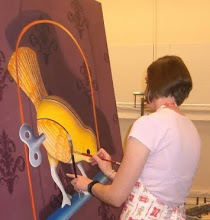
I have always preferred painting to drawing but recently made it a goal to improve my drawing skills. This particular mixed media piece is dear to my heart because it is the first sketch that began my journey to becoming a better draftsman (draftslady?). Drawing is now a great passion of mine.

Saturday, March 14, 2009

The Greater Adjutant

The Greater Adjutant is a disturbing-looking scavenger that can reach a height of 5 feet. They have disappeared from most of their historic range in India due to habitat loss. The species is globally threatened, with a total population thought to number no more than a thousand. A small remaining number of these birds can be found feeding in garbage heaps in Vietnam and Thailand.

I saw a photo of a lone Adjutant atop a mountain of trash and was immediately intrigued by this bird. I have always found a quiet sense of beauty in filth and ugliness.